
Modeling a 2-Meter Ham Radio Station in MATLAB
I modeled a real VHF ham radio station from transmitter to antenna to receiver, then studied how antenna tuning and feedline loss affect communication range
PROJECTS
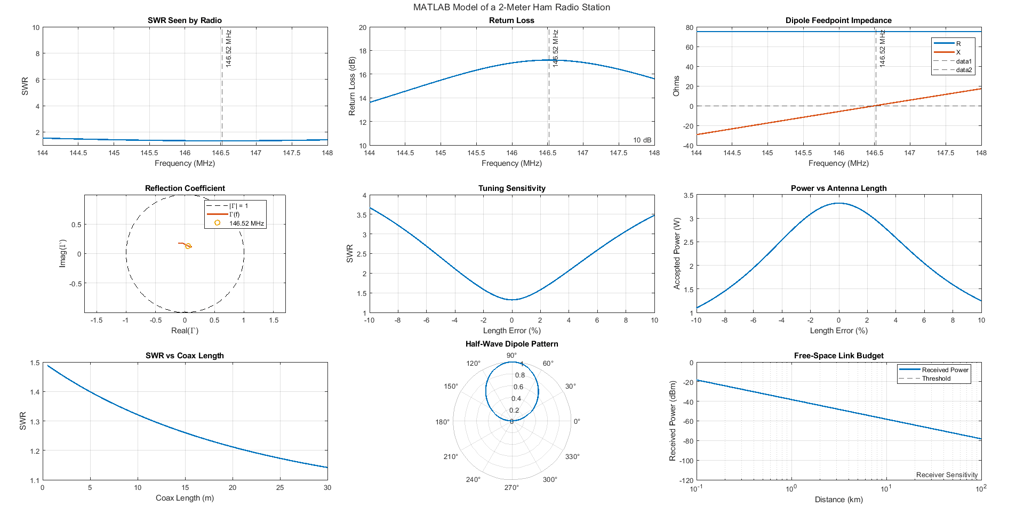
I built an end-to-end MATLAB model of a 2-meter amateur radio station to study how antenna design, feedline loss, impedance matching, and propagation affect real RF system performance. The model focuses on a VHF simplex setup operating near 146.52 MHz, representing a typical ham radio station with a transmitter, coaxial feedline, antenna, and distant receiving station.
The project models a 50-ohm RF source driving a coax feedline and half-wave dipole antenna. I used antenna impedance and radiation-pattern analysis to evaluate how antenna length affects resonance, SWR, and radiated power. I then added a feedline and link-budget model to estimate how much power reaches a receiving station over distance.
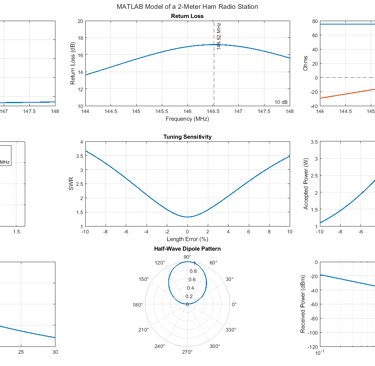
The simulation generates plots for antenna impedance, S11, SWR, Smith chart behavior, radiation pattern, delivered power, and received power versus range. I also performed parameter sweeps over antenna length, coax length, transmit power, and distance to understand which variables most strongly affect communication performance.
This project helped connect circuit-level RF concepts to practical radio operation. The main result was that antenna tuning and feedline loss can significantly affect the amount of power actually radiated, even when the transmitter output power stays constant. The model also showed how line-of-sight range, antenna gain, and receiver sensitivity determine whether a VHF radio link is likely to close.
Future work includes validating the MATLAB model with NanoVNA antenna measurements, comparing different antenna geometries such as a quarter-wave ground plane and J-pole, and adding terrain-aware coverage estimates for real repeater or simplex paths.